Monday, February 04, 2019

EASY GO by Michael Crichton (as by John Lange)


In the late 1960s and early 1970s Michael Crichton published eight thrillers under the pseudonym John Lange.  The Lange novels are something very different than the science fiction Michael Crichton became famous for writing.  They are thrillers more in the vein of Desmond Bagley, Jack Higgins, and Gavin Lyall, and I like them much more than Crichton’s big bestsellers.
Harold Barnaby is an Egyptologist in an age when nothing new or interesting is happening in the field.  His specialty is hieroglyphics, and while translating a text he discovers a reference to the tomb of an obscure Pharaoh in the Valley of the Kings.  In earlier years Barnaby dreamed of the glory of discovering an Egyptian tomb, but now, at the age of 41, he is less interested in glory and more interested in wealth.  He approaches a freelance writer named Robert Pierce with an ambitious plan to loot the tomb, which he estimates to be worth, in 1968 dollars, $50 million.
The novel is written in third person, and is structured in three titled acts—The Plan, The Search, and The Last Tomb.  The scene titles are self-descriptive.  The Plan introduces the genesis of the idea, the plan, and the compilation of the team.  The team arrives in Egypt in the second act, and the third act is the resolution.
Easy Go is all story.  It opens with a flash, and it races from the first page to the last.  The setting is surprisingly rich, and provides, in stark prose, the sounds, smells, and sights of the land—
“The land was flat, desolate, windy; there was no vegetation, no sign of life.”
“The modern traveler’s first view of Egypt is appropriate: Cairo airport, set out in the flat, brown sand of the desert stretching away in silent heat for miles.  It is a landscape that communicates, quite distinctly, a sense of agelessness, unchanging, interminable.”
“The villages were all the same—mud huts, dusty streets, and date-palm trees, stately camels and barking, hungry dogs.”
Easy Go is a thriller as thrillers were meant to be.  It is quick, light, and entertaining as hell.  There isn’t the slightest bit of character development, but it is populated with an exotic group of characters.  There is the wealthy British nobleman financing the operation on a whim who travels with, at a minimum, two young ladies, there is the smuggler, and the thief.  It is exciting, and with just enough of a twist at the end to bring a smile.
Easy Go was originally published in 1968 by Signet and it was republished as The Last Tomb by Bantam in 1974. It was reissued as with its original title by Hard Case Crime, along with Crichton’s other John Lange titles, in 2013.

Monday, January 28, 2019

Thrift Shop Book Covers: "The Blessing Way"

The Blessing Way, by Tony Hillerman, was published as a hardcover by Harper & Row in 1970, but the edition that caught my eye was Avon’s 1978 paperback edition. The desert background, frightening wolf headpiece shadow, and the Navajo artifact make for an intriguing and alluring temptation to open the book. The artist: Unknown (to me at least)


The first sentence:
Luis Horseman leaned the flat stone very carefully against the pinon twig, adjusted its balance exactly and then cautiously withdrew his hand.
The Blessing Way was Tony Hillerman’s first novel, introducing his long-time series character Detective Joe Leaphorn. In later novels, Leaphorn was joined by Navajo Tribal Police Officer Jim Chee.

Tuesday, January 22, 2019

AT FIRST SIGHT by Stephen J. Cannell


Stephen J. Cannell’s fourteenth novel, At First Sight, received mixed reviews from the critics when it was released in 2008.  Publishers’ Weekly called it “disappointing,” and Booklist said it “might be his best novel yet.”  After reading it this past weekend I’m leaning more towards Booklist’s opinion than PW’s.  
Chick Best is a self-made millionaire.  He hit it big with an Amazon-type Internet company, but the good days are gone.  Now he is stuck with an expensive weight lifting wife, an angry drug addicted daughter, and selling his company for pennies on the dollar.  And worst, he is losing his credentials—the envy his wealth and possessions generates in others.  Suffice it to say Chick is a pathetically shallow man.
Chick and his family vacations in Maui each Christmas, and Chick’s dead end trajectory gets a lift when he spots the most beautiful woman he has ever seen.  The woman is soft in that feminine way and gorgeous, which is the complete opposite of his hard body wife who spends more time discussing abs, quads, workout programs, and scowling (at least at Chick) than anything else.   
He immediately formulates a plan to meet the woman (Paige Ellis), who is married to a likable old money school teacher who is more concerned with learning disabled children than wealth.  A mind set Chick finds confusing and annoying.  The two couples become friends during the week, and when the vacation is over Chick can’t get Paige Ellis out of his mind.  On a New York business trip he detours to the Ellis’s North Carolina home where he begins his plan to win Paige.
At First Sight is written in both first and third person.  There are three acts—the first is narrated by Chick alone, the second is narrated by both Chick in first person and Paige in third person, and the third is narrated by Paige in first person and Chick in third person.  The changing perspective creates tension and builds doubt between the reader and Chick.  Chick is a sympathetic narrator in the first act, but as the reader is exposed to additional information from outside it becomes clear Chick is untrustworthy.
While Chick may be less than honest, his portions of the novel are pure gold.  He narrates with a snarky wit, which is funny in the first half of the novel, but as his true character is revealed it becomes ominous.  He turns out to be such a loathsome character I found myself uncomfortable with my original opinion of both him and his and wit; as though liking him in the early stages of the novel illuminated something unsavory about my own character.
At First Sight is pretty terrific.  It is a fast moving story, which is cleverly plotted and told with a flash bang style and wit.  There are moments Chick’s narrative is laugh out loud funny—particularly when he is describing his daughter, wife, and his wife’s trainer Mickey D:
I let it happen, though, because I didn’t think in four days Evelyn would be able to turn Paige’s softness into the kind of anatomical gristle that she had struggled so hard to achieve for herself.
At First Sight is the best of the handful of Stephen J. Cannell’s novels I have read, and it’s a shame he didn’t write fewer of his Shane Scully novels and more like this.


Monday, January 14, 2019

Thrift Shop Book Covers: "Farewell, My Lovely"

Farewell, My Lovely, by Raymond Chandler, needs no introduction from me, but here it is anyway. The second novel to feature Philip Marlowe was published by Alfred A. Knopf in 1940. The edition that caught my eye, and for more reasons than the cover (see the inscription on the title page below), is the 1976 mass market published by Vintage Books. The artist: Richard Waldrep


The first paragraph:
It was one of the mixed blocks over on Central Avenue, the blocks that are not yet all Negro. I had just come out of a three-chair barber shop where an agency thought a relief barber named Dimitrios Aleidis might be working. It was a small matter. His wife said she was willing to spend a little money to have him come home.


But it’s the inscription that sold me the book:

Wednesday, January 09, 2019

2018: The Year in Reading


2018 was a great year for reading. I finished, and this is an amazing number for me, 64 titles, which is nine more than last year’s mark and eight more than 2016’s. The majority of the titles were fiction, but I did increase my nonfiction intake significantly over last year, which is good because my only reading goal for 2018 was:
Read more non-fiction!
Whew. I love it when a plan comes together. 
My fiction reading is littered with the old and familiar. If there is an author in general, or a novel or story in particular, I like, I will read it over and over. While my fiction reading in 2018 was dominated by my obligations to Mystery Scene Magazine—thirty titles, novels, collections, and anthologies, plus a bunch of magazines, which aren’t included in my reading totals (and that may change in 2019)—I was still able to read some old favorites. I read two novels by Stephen Mertz, including his excellent private eye novel, Say it Was Murder, the first Wyatt novel, Kickback, for the second time by Australian author Garry Disher. I re-read Jack M. Bickham’s Overhead (my fourth or fifth reading of this title), and Ed Gorman’s The Day the Music Died. 
But I also read a bunch of authors new to me—25 in total—including impressive works by Richard Prosch (Peregrine Returns), J. Michael Orenduff (The Pot Thief Who Studied Edward Abbey), Matt Wesolowski (Hydra), Linwood Barclay (A Noise Downstairs), Steve Goble (The Devil’s Wind), Joe Ide (Wrecked), Helene Tursten (An Elderly Lady Is Up To No Good), Graeme Macrea Burnet (The Accident on the A35), Henry Kane (Frenzy of Evil), and Ralph Dennis (Atlanta Deathwatch and The Charleston Knife is Back in Town).
And my reading list in 2018 featured a few titles that rose to the top, which I skimmed (with some difficulty) down to five titles. With that said, my five favorite fiction titles that I read in 2018 are (and in no particular order):
·         The Red Scarf, by Gil Brewer, is pure, wonderful noir, about a man with a penchant for losing. And his every decision assures him a disastrous fate. Look for a more detailed discussion of this title in an upcoming feature at Mystery Scene Magazine’s website.

·         The Charleston Knife is Back in Town, by Ralph Dennis, is the second outing for former disgraced Atlanta police officer, and unlicensed P.I. Jim Hardman. A seamless tale in the vein of Robert B. Parker’s Spenser novels, but with a working class vibe. Look for a more detailed discussion of this title in an upcoming feature at Mystery Scene Magazine’s website.

·         An Elderly Lady Is Up To No Good, by Swedish writer Helene Tursten, is a collection of five tales with octogenarian Maude doing what she does best, murdering her neighbors for some well-deserved peace and quiet. I reviewed this title for my review column, “Short & Sweet: Short Stories Considered”, and you can read it at Mystery Scene’s website.

·         Wrecked, is Joe Ide’s third novel featuring private eye and general good guy, IQ. A furious and fun private eye novel that is as much thriller as anything else. You can read my review at Mystery Scene.

·         Say It Was Murder, by Stephen Mertz, is a private eye novel for the 21st century. Stylish, modern, and it turns a trope or two upside down. Read my Gravetapping review.
And here are a few honorable mentions. Hydra, by Matt Wesolowski, Word of Honor, by Nelson DeMille, Rape: A Love Story, by Joyce Carol Oates, The Peacemaker, by Andrew McBride, The Devil’s Wind, by Steve Goble, Shutter Island, by Dennis Lehane, Bryant & May: Hall of Mirrors, by Christopher Fowler, and Frenzy of Evil, by Henry Kane.


Sunday, January 06, 2019

THE LAWBRINGERS by Brian Garfield


Another older review of an early Brian Garfield western novel. Mr. Garfield passed away, after a years-long battle with Parkinson’s disease, on December 29, 2018. When I have a hole in my reading list I’m going to read a couple of his suspense novels, but until then, here is a review of The Lawbringers.
The American western novel has a bad reputation. It is reputed to be ethnocentric, violent and, even worse, simple and inaccurate. The good guys are too good, the bad guys are too bad, and the natives are one-dimensional cutouts. The townsfolk—the common working class—are portrayed as stupid, weak, or both. 
In many cases this poor reputation is deserved—there have been some really, really bad westerns introduced on television, film and fiction. There have also been some damn good westerns over the years—both past and present. To quote Theodore Sturgeon—he was defending SF, but the same rule applies to westerns—“ninety percent of everything is crap.” It is the other 10 percent that separates a viable genre from a dead one and the western is far from dead, whether we are talking about golden age stories or the novels published today.
An example of an older title—it was published by one of the more maligned houses, Ace, in 1962—that holds its own against the often valid arguments against westerns is Brian Garfield’s The Lawbringers. It is a traditional western from beginning to end. It is short, seemingly simple, and very much to the point, but it is also clever, intelligent, and subtly complex.
The Lawbringers is a biographical novel about the formation of the Arizona Rangers—a law enforcement agency created by the territorial Governor to combat the seemingly endless supply of toughs and criminals that haunted Arizona in the late-nineteenth and early twentieth centuries. Its focus is directed at the chief Ranger, one Burton “Cap” Mossman, but it is told in an unexpected way. It is a multi-perspective novel that never attempts to get into the head of Mossman. Instead he is painted and defined by the characters around him—some real, others created by Garfield—as a hard, stubborn and tough man.
The novel is dedicated to Burt Mossman—“a chivalrous gentleman, a lawman, and an Arizonan.” But it is far from a one-sided novel of adoration. It tackles the man’s complexity as well as his flaws. He is depicted as a hard man doing a hard job. His decisions are made with the citizens of Arizona in mind, but with a frightening lack of color. There are no gradient shades, but rather his view is strictly black and white, and more often than not the end justified the means. He wasn’t above lynching a man to make his point, and the Mexico-Arizona border was less an end to his jurisdiction and more an artificial line to be ignored.
Mossman is a man who withstood political pressures and did what he thought best no matter the consequences. He typified the mythical western protagonist, but is portrayed by Mr. Garfield as nothing more than a man—stubborn, sincere, and flawed. He had friends, enemies, and admirers, but he hid behind a wall of secrecy and loneliness. He was a man that fit into the demands of an era, but whose era passed quickly and without much fanfare.
The Lawbringers manages to does all that and also tell an exciting and tight tale. It has a peculiar heavy quality. It is packed with emotion and wonder; wonder at the basis of right and wrong. It has a conscience without being limited or judged by that conscience. It is complex and wondrous. In short, it is very much part of that 10 percent, which has allowed the western story to survive for more than a century.

Friday, January 04, 2019

CALL ME HAZARD by Brian Garfield


Brian Garfield died on December 29, 2018. He was a wonderful writer and storyteller. He started as a western writer, many of his early westerns were published in hardcover by Avalon and then republished in paperback by Ace, as doubles and sometimes as singles. He also wrote several original novels for Ace, and here is an older review, originally written in 2009, for one such title, Call Me Hazard.
It has been a summer of great older stuff at my house, and one of the fascinations I developed is the work of Brian Garfield. I read a handful of his novels and reviewed two—Necessity and Fear in a Handful of Dust. My latest Garfield experience is a Western he wrote for the ACE Double line titled Call Me Hazard. It was published as by Frank Wynne in 1966 (M-138 with The Rincon Trap by Dean Owen), and while it isn’t the top of his work it is pretty damn good.
Jason Hazard is a hard case. He isn’t a bad man, nor is he the type who looks for trouble, but nonetheless he is hard, silent, and (when he needs to be) violent. He is also a mystery—the people around him respect and admire him, but Hazard always holds back. When he left his successful mine, and the town of Stinking Springs, Arizona, he didn’t tell many why. He just left and there were a few who took exception to his absence.
Hazard is back in Stinking Springs, but he doesn’t find a warm welcome. There is a new mine owner in town. A man named Vic Olsen who has a long history with Jason—it goes back to their teenage years—and his major ambition in life is ruining Jason’s. The other major mine owners in town are all having trouble too. The place seems jinxed. There have been an abundance of cave-ins and payroll robberies, and most of the owners are contemplating selling out and moving on.
The foreman of the largest operation has gone missing and the local law—a tiny man named Owney Nash, who is owned by the new player—thinks Hazard did it. Hazard hasn’t seen the foreman since he left years earlier, but as he walks into Stinking Springs all hell breaks loose and he will need the few friends he has left in town to survive.
Call Me Hazard is an early example of Garfield’s work. His trademarks are all there—the tight and controlled suspense, the crisp dialogue and competent and literate writing—but it isn’t as sharp or developed as his later work. The story is larger than the space allowed. The plot is tricky and Garfield does well at packing it in to 126 pages, but it would have worked better with more room and run time.
With that said, Call Me Hazard is really entertaining. It is a traditional Western with everything from hired guns, to nefariously beautiful women, and cold-blooded murder. It even has a few humorous names, of which Hazard and Stinking Springs are only two. The lead is a stolid and quiet man who isn’t a hired gun or even a loner. He left Stinking Springs for a reason and everyone who knows why he left is more than glad to see him back.
There is one particular scene—the first major showdown between the protagonist and the villain—that is as suspenseful as any scene in a successful suspense novel, which is Brian Garfield’s calling card. His work, no matter the genre, is plotted to ratchet the suspense from scene-to-scene and Call Me Hazard is no different. It is early and a little too short, but it is all entertainment and a fine example of how good—even at the age of 27, which is how old Garfield was when he wrote Call Me Hazard—Brian Garfield is.

Piccadilly Publishing has released a few of Brian Garfield’s early, pulpy, western novels as low-priced e-books over the past several months, including Mr. Sixgun, The Night it Rained Bullets, and The Bravos. Also available, from Mysterious Press, are some of Garfield’s later western novels: Manifest Destiny, Wild Times, Tripwire, Sliphammer, and many others.


Monday, December 31, 2018

My Favorite Short Mystery Stories of 2018


Since taking the reins of Mystery Scene Magazine’s “Short & Sweet: Short Stories Considered” column a few years ago my reading of short mystery fiction has increased significantly. During 2018, I read—and this is a less than scientific estimate—somewhere greater than 500 crime and mystery short stories. The stories were published in magazines—Alfred Hitchcock, Ellery Queen, Black Cat, Down & Out—anthologies and collections. The individual stories have a tendency to slip from my awareness shortly after the final words have been read, but there are those stories that stick to me. Often becoming something better and more real in the weeks and months after I’ve read the tale. 
This year, for something a little different, I decided to sit down and compile a list, from memory rather than going back into the books and magazines or the reviews I wrote, of my five favorite mystery short stories. And, no matter how hard I tried, I was unable to settle on less than six stories. So, without further ado, here are my five six favorite short stories (in no particular order) published during 2018*.
“An Elderly Lady Seeks Peace at Christmastime” by Helene Tursten, featuring the homicidal octogenarian Maude, who will do anything for peace and quiet. [An Elderly Lady is Up To No Good, Soho, November 2018] 
“The Little Men” by Megan Abbott, is a Hollywood story with an ironic and very twisted ending. [Bibliomysteries Volume Two, edited by Otto Penzler, Pegasus, August 2018]
“Fair Game” by Max Gersh, is a carnival tale reminding us that the house always wins. [Alfred Hitchcock Mystery Magazine, March / April 2018]

“Backfire” by Floyd Mahannah, is a vintage crime novella that is hardboiled, and perfectly plotted. [The Broken Angel / Backfire and Other Stories, by Floyd Mahannah, Stark House, May 2018]
“Phantomwise: 1972” by Joyce Carol Oates, is a long story about sexual harassment and murder. [The Best American Mystery Stories 2018, edited by Louise Penny & Otto Penzler, Mariner, October 2018]
“The Wild Side of Life” by James Lee Burke, is an old school paperback era story about men and women and trouble. [The Best American Mystery Stories 2018, edited by Louise Penny & Otto Penzler, Mariner, October 2018]

*A few of the stories were originally published prior to 2018, but reappeared in author collections or best of the year anthologies.


Tuesday, December 25, 2018

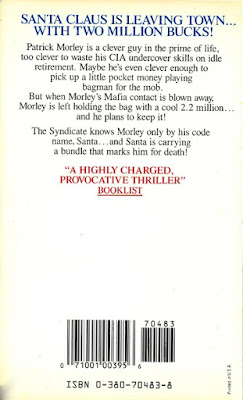
Thrift Shop Book Covers (Christmas Edition): "A Present for Santa"

A Present for Santa, by James Burke, is a crime novel published in hardcover by St. Martin’s Press in 1986, but the edition that caught my eye is the mass market paperback published by Avon in 1989. The artist: Unknown (to me at least)

The first paragraph:

It was raining hard, but the brunt of the rush hour traffic was off the streets, so the dark coupe was making good time up the Drive. The blond man, driving alone, was handling the car mechanically, his mind far from Chicago’s glistening streets.
James Burke wrote three novels in the mid- and late-1980s; two, including A Present for Santa, featured retired CIA operative Patrick Morley. And, you've probably already guessed, so far as I know, there is no relation between this James Burke and James Lee Burke.

Wednesday, December 19, 2018

Thrift Shop Book Covers: "Christmas Stars"

Christmas Stars, edited by David G. Hartwell, is a Christmas-themed anthology published as a paperback original by Tor in 1992, which is the very edition that caught my eye. The cover is Santa Claus perfect with its spacesuit clad St. Nick and reindeer. The artist: Nick Jainschigg


The first sentence from Frederik Pohl’s “Adeste Fideles”:
   A Christmas was only an abstraction on Mars, even for Henry Steegman.
Included in the anthology are 25 stories from Ray Bradbury, William Gibson, Ben Bova, Arthur C. Clarke, Jack McDevitt, Brian W. Aldiss, and many others.

Monday, December 17, 2018

SHADOW GAMES by Ed Gorman


I have a particular fondness for Shadow Games. It is not only a terrific novel, but it was my introduction to the work of Ed Gorman. The year was 2000. I made a habit of studying and writing in a library not far from where I worked as a pizza delivery driver; a job I won’t recommend, but a job that treated me well as I navigated the college scene. My usual table was tucked at the back of the fiction stacks. I sat, my back to the wall, facing a bookshelf packed with the latest genre titles making study nearly impossible since the stories beckoned me. 
There was one title that, day after day, caught my attention. It was a mass market paperback, black background with orange-red print and the large white Leisure Books’ logo—a publisher I miss badly—at the top of its spine. Its title, Shadow Games. When I finally relented and read Shadow Games, sitting right there in the library, its tale of Hollywood ambition, perversion, and lost potential, all told in a darkly humorous tone, made me a lifetime fan of Ed Gorman’s work. 
It is the story of Cobey Daniels, a child television star, musician and, as the novel opens, the playwright and star of his own one man show. The play is autobiographical and humorously recalls Cobey’s life as a fallen Hollywood superstar. A life that has had more than a few public scandals. The most serious involved a sixteen-year-old girl in a Miami, Florida mall causing Cobey’s three-year stay in a Missouri mental hospital. But Cobey is better now, the addictions and mood swings are behind him. Or so Cobey thinks until he awakens in a Chicago apartment, difficulty remembering his name, a headless woman lying in a pool of her own blood on the kitchen floor. 
Shadow Games is a dark ride across American pop culture—hero worship, sex, vanity, dizzying unreality, hypocrisy, cynicism and downright craziness. It is a crime novel at its center, but its view of Hollywood and its fandom illuminates modern culture in a manner both convincing and familiar. It is dark, possibly one of the three or four darkest tales I’ve read, but its humor—
“‘I know a lot of people think I’m a goody-goody because of my role on the show. Well, what’s wrong with being a clean-cut, all-American teenager?’ 
“Cobey Daniels, interviewed in Teen Scene, August, 1984”
“(Reporter)   The police are saying that you pulled a knife on the waitress because she wouldn’t serve you liquor. Any comments?
“(Cobey)   Yeah, just one. Why don’t you go f*ck off, you asshole? 
“Cobey Daniels responding to KABC-TV reporter, May, 1985”
—lifts it from what, in lesser hands, could have been a deeply depressing story to a very readable and damn good novel.
Shadow Games, as it should be, is back in print with a high quality trade paperback from Short, Scary Tales. It has been, from what I can tell, lightly edited by the author and is titled Shadow Games and Other Sinister Stories of Show Business. It includes four of Ed Gorman’s finest short stories, “Scream Queen,” “Riff,” “Such a Good Girl,” and “Pards.” Do yourself a favor and buy it right now.
This review originally went live May 11, 2016. Unfortunately, the Short, Scary Tales edition has left print, but Shadow Games is still available as an ebook.

Wednesday, December 05, 2018

"The Santa Claus Murders" by Ed Gorman


A Christmas novella featuring Ed Gorman’s Sam McCain, originally published in Crooks, Crimes and Christmas (Worldwide, 2003) and, as far as I know, currently out-of-print.
Sam McCain’s only reason to attend a high school reunion / Christmas party is a hope there will be attractive, available, attentive former female classmates. The party is at the home of the wildly wealthy Don Lillis, who inherited the house and a steel mill from his father. On his arrival, Sam finds the usual clustering of people. The wealthy and upwardly mobile, the weirdoes, the blue-collar-types, all congregating in their respective groups. Sam has the uncanny ability to move from group to group, but he doesn’t quite belong to any of them. 
The party turns bad when Bob Nugent, the class drunk, is found in the guest room with a knife in his throat. Bob Nugent was the kid everyone expected to succeed. In school, Bob worked hard, was kind, friendly and the teachers loved him. He was, to Sam’s thinking, a brownnose of the first order. But something went wrong for Bob during his college years and he started drinking. The party screeches to a halt when Bob’s body is found and the unlikable and incompetent Sheriff Cliff Sykes, Jr is called to investigate. Cliffie, as he is called behind his back, makes all the wrong assumptions and McCain decides to solve the mystery on his own for two reasons: to make Sykes look the clown, and to make sure the right person is brought to justice.
“The Santa Claus Murders” is Sam McCain at his best. He is young, endowed with the wisdom of a much older man, intelligent and savvy at why people do what they do, and cynical with a perfectly complimented amount of optimism. He is a kid that doesn’t quite fit a category—he grew up in the poor section of town, but he is a college graduate with his own small law practice. He is an ideal Ed Gorman character: intelligent, cynical, tough, realistic, and yet hopeful and wistful at the same time.
The mystery is perfectly executed. The killer is revealed only moments after the reader figures it out. The supporting cast is top-notch. Cliffie Sykes is his usual gruff and annoying self. The Judge is kind and vindictive in a swift, judgmental and condescending manner. And everyone else plays their parts perfectly.

Monday, November 19, 2018

Thrift Shop Book Covers: "The Warsaw Document"

The Warsaw Document, by Adam Hall, was published as a hardcover by William Heineman Ltd in 1971, but the edition that caught my eye was the paperback edition published by Fontana in 1978. The cover is cold war perfect with a Mercedes—the choice of every good spy—running a barricade. The artist: Tony Roberts


The first paragraph:
There would be no warning, I knew that.
The Warsaw Document, is the fourth (of 19) novels featuring British spy Quiller. The Quiller books were published as by Adam Hall, which was a pseudonym for Elleston Trevor.

Tuesday, November 13, 2018

JIMI AFTER DARK by Stephen Mertz


Jimi After Dark is the second novel in what I think of as Stephen Mertz’s musical mystery series, which isn’t an accurate moniker since the books are as much about the time and place of the tales’ setting as they are about the music and musicians. The first, Hank & Muddy (2011), was set in the 1950s and featured Hank Williams and Muddy Waters. Jimi After Dark is a 1960s novel set in 1970 London, near the end of Jimi Hendrix’s too-short life. Its genesis, as Mr. Mertz explains in his Afterword, is Jimi’s mostly disbelieved kidnapping claim by armed thugs and his ultimate rescue by other armed men.
From the start, Jimi is in trouble, legal trouble with his former manager Mike Jeffrey and another, more violent, trouble with more than one unknown source that may, or may not be related to the Kray Brothers—the East End crime syndicate brothers in prison when the story begins—and the Central Intelligence Agency. Jimi calls on his old Army buddy, unnamed in the story and simply called Soldier, for help. Soldier is fresh from his second tour in Vietnam with a tendency towards violence and a strong sense of duty and loyalty, which acts as an effective literary foil for Jimi’s hippie and gangster filled world.  
Jimi After Dark is an action crime novel with nicely executed action scenes, a few twists, and big ideas: friendship, loyalty, betrayal—the unexpected betrayal of friends and lovers and the more expected betrayal from governments—duty, honor, and the relationship between music and culture. The 1960’s culture war is dissected, Jimi on one side and Soldier on the other, wrapped inside a well-told, exciting story with the cleanest, strongest prose in the business. Jimi After Dark is Stephen Mertz’s best novel, and it should be on everyone’s reading list.

Tuesday, November 06, 2018

COME OUT TONIGHT by Richard Laymon

Richard Laymon is a legend in the horror genre. His work is brutal, violent and, at times, almost pornographic. His novel Come Out Tonight is no exception. It is the story of Sherry Gates and her scrape with a demented underage serial killer.
The novel opens with Sherry sending her boyfriend, Duane, to a local convenience store for condoms. When he doesn’t return she gets nervous and goes out looking for him. She finds Duane’s van, but she doesn’t find him. This sparks an all-night search, a chance meeting with a helpful older man and an encounter with two charmingly innocent teenage boys. And, somewhere in between, she is kidnapped, beaten, and raped. The plot takes a number of surprising turns. And in the end, it becomes difficult to tell the good guys from the bad.
Come Out Tonight opens with a bang. The prose is quick and sharp. The story is interesting and the characters are fun, even if a little familiar to anyone who has read Richard Laymon’s work. It is dialogue rich, and a very quick read. Unfortunately, like many of Laymon’s novels, it lacks a certain amount of believability. It is difficult to ignore the glaring fact that all of this pain, fear and horror could be escaped by simply picking up the telephone and dialing three numbers: 9-1-1.
While the characters motives are suspect, and not adequately explained, this is still a fun novel. The reader just has to ignore the obvious holes in the plot, and the fact that Laymon’s characters never make the right decision. They always run down the wrong corridor, or choose the wrong road, or alley. They are innocent, or ignorant, of their true situations, and they always think they can handle it. They never, when it is available, ask for help. And, of course, their actions always lead them into deeper, darker and more frightening places.
Fortunately, it isn’t very difficult to ignore the novel’s weaknesses. Richard Laymon can weave a damn good story and make you want to ignore the blemishes. He does it with a sturdy understanding of the tale and its impact on the audience. He tightens the suspense like a noose around the reader’s neck. He makes you want to believe the tale. It is very much like a campfire story. You know it is not real, and could never be real, but somehow it still enthralls and even scares you.
The action is violent and stuffed with sex—most of the novel is filled with sexual torture, but somehow, as written by Laymon it is less disturbing and nasty than it could be; perhaps because it is seemingly written through the eyes of a thirteen year-old boy. It is more fantasy than reality. And that fantasy is somehow innocent and almost coy.
Come Out Tonight is not for everyone. If you are offended by violence, sex, or just about anything else, avoid this book. If, on the other hand, you like a little heady action and quick-shot violence you just might like this offering. Be careful and don’t take it too seriously, or we all may have to question both our sensibilities and our sanity.