Showing posts with label Hard Case Crime. Show all posts

Saturday, January 23, 2021

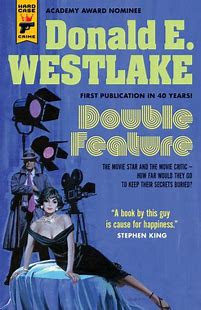
DOUBLE FEATURE by Donald E. Westlake

Double Feature, a 2020 release from Hard Case Crime and originally published as Enough in 1977, includes a short novel and a novella. The novel, A Travesty, is a slanted whodunit, which is more of a can-he-get-away-with-it since the protagonist – a film critic – is the murderer doing anything he needs to do to stay out of prison. A humorous story that begins with the genre’s usual, but grows into something quite original. The unexpected, but perfectly ironic ending, gives it a smile-inducing appeal.

The novella, Ordo, is more hardboiled than its pairing, and my favorite of the two because of its working class narrative. A career navy man, Ordo, discovers his short-time wife of fifteen years earlier has become a Hollywood sex symbol. She is unrecognizable as the girl he knew, and Ordo wants to figure out how his ex-wife became someone else. What he discovers is painful and melancholy, but has a purely American vibe of creating your personal mythology; similar to F. Scott Fitzgerald’s The Great Gatsby, but much less sinister.

Double Feature is a great pairing of tales, told in different styles and with contrasting themes, that showcase Westlake’s brilliance as a storyteller.

Monday, February 04, 2019

EASY GO by Michael Crichton (as by John Lange)


In the late 1960s and early 1970s Michael Crichton published eight thrillers under the pseudonym John Lange.  The Lange novels are something very different than the science fiction Michael Crichton became famous for writing.  They are thrillers more in the vein of Desmond Bagley, Jack Higgins, and Gavin Lyall, and I like them much more than Crichton’s big bestsellers.
Harold Barnaby is an Egyptologist in an age when nothing new or interesting is happening in the field.  His specialty is hieroglyphics, and while translating a text he discovers a reference to the tomb of an obscure Pharaoh in the Valley of the Kings.  In earlier years Barnaby dreamed of the glory of discovering an Egyptian tomb, but now, at the age of 41, he is less interested in glory and more interested in wealth.  He approaches a freelance writer named Robert Pierce with an ambitious plan to loot the tomb, which he estimates to be worth, in 1968 dollars, $50 million.
The novel is written in third person, and is structured in three titled acts—The Plan, The Search, and The Last Tomb.  The scene titles are self-descriptive.  The Plan introduces the genesis of the idea, the plan, and the compilation of the team.  The team arrives in Egypt in the second act, and the third act is the resolution.
Easy Go is all story.  It opens with a flash, and it races from the first page to the last.  The setting is surprisingly rich, and provides, in stark prose, the sounds, smells, and sights of the land—
“The land was flat, desolate, windy; there was no vegetation, no sign of life.”
“The modern traveler’s first view of Egypt is appropriate: Cairo airport, set out in the flat, brown sand of the desert stretching away in silent heat for miles.  It is a landscape that communicates, quite distinctly, a sense of agelessness, unchanging, interminable.”
“The villages were all the same—mud huts, dusty streets, and date-palm trees, stately camels and barking, hungry dogs.”
Easy Go is a thriller as thrillers were meant to be.  It is quick, light, and entertaining as hell.  There isn’t the slightest bit of character development, but it is populated with an exotic group of characters.  There is the wealthy British nobleman financing the operation on a whim who travels with, at a minimum, two young ladies, there is the smuggler, and the thief.  It is exciting, and with just enough of a twist at the end to bring a smile.
Easy Go was originally published in 1968 by Signet and it was republished as The Last Tomb by Bantam in 1974. It was reissued as with its original title by Hard Case Crime, along with Crichton’s other John Lange titles, in 2013.

Tuesday, December 05, 2017

QUARRY'S CLIMAX by Max Allan Collins


Quarry’s Climax, the fourteenth title in Max Allan Collins’ revitalized Quarry series, is set in the Highland Strip area of Memphis in the autumn of 1975. The Memphis setting is a “hat tip” to the Cinemax television series based on the novels, which relocated Quarry from his literary Midwest roots to the birthplace of the blues. Quarry, a contract killer, is given the unusual assignment of stopping a hit on Max Climer. Climer is a strip club owner that expanded his business to publish the very adult and very raunchy Climax Magazine, and someone wants him very dead.
Quarry’s business agent, The Broker, is an investor in Climer’s enterprises and he wants Quarry to thwart the hit, and then determine who ordered it. The list of potential suspects is long. Climer is a target of women’s rights groups, religious groups, and business rivals. The Broker sends Quarry undercover as a security consultant, which gives him free access to Climer’s offices and the strip joint below, The Climax Club. The music is blaring, the girls are willing, and Quarry is his cool, composed self.
Quarry’s Climax is a smoothly entertaining tale with sex—Quarry attracts strippers like johns to hookers—violence, and a road map of mid-1970s music. The linear story is told with a stripped-down style, almost like a beer bar chat between reader and Quarry, and plotted with enough twists to keep the pages turning. But it is Quarry, his self-deprecating coolness, dry humor and 1970s social commentary (with a tour guide quality), that makes this one worth reading.


Thursday, October 22, 2015

JOYLAND by Stephen King

Hard Case Crime recently released a new Stephen King novel—straight to trade paperback—titled Joyland.  It is a short novel, probably not much more than 50,000 words, but it is Mr King’s best work in several years.  Joyland is a difficult novel to categorize.  It is part supernatural ghost story and mystery, but it doesn’t easily fit into either, or even both categories.  It is something approaching a working class soliloquy.  It is narrated as though the protagonist is speaking to himself attempting to find the truth hidden in the story’s events.

Devin Jones is an early-twenties college student with an unfaithful girlfriend, a mourning father, and a dead mother.  In the summer of 1973 Devin takes a job at an amusement park in the small resort town of Heaven’s Bay, North Carolina, called Joyland.  The summer changes Devin; he meets two life-long friends, a murderer, a dying boy, and in the process discovers adulthood.
The story is centered on two primary events.  The first is a murder in the funhouse of Joyland, which occurred a few years before the story begins, and the second is Devin’s introduction to a dying boy named Mike.  The two story lines run parallel, but neatly and satisfactorily collide in the final climax.     

Joyland is a carnival novel—every horror writer should have one—but it is much more.  It is a coming of age story where the protagonist is dragged into adulthood by circumstance; a truer understanding is achieved, and the naiveté and brilliance of youth is forever lost.  It is a sad and wistful tale, but it doesn’t dwell on sorrow; rather it is more about hope than anything.  The opening lines frame the mood and pacing of the novel perfectly:
“I had a car, but on most days in that fall of 1973 I walked to Joyland from Mrs. Shoplaw’s Beachside Accommodations in the town of Heaven’s Bay.  It seemed the right thing to do.  The only thing, actually.” 

Joyland is a small masterpiece.  It is smoothly readable, and while it tells a story of meaning it does so with a strong and interesting story.  It is anything but HCC’s usual fare, but it is an appealing novel, which should be well liked by Mr King’s usual suspects, HCC’s readers, and a bunch more.  You should try this one.


Sunday, August 30, 2015

THE MURDERER VINE by Shepard Rifkin

Every so often a novel sneaks up on me.  It catches me unprepared for its power.  It sits with me long after its last page has been turned, and the narrative swirls around the edges of my intellect.  I read such a book recently.  It is titled The Murderer Vine.  It was written by a mostly forgotten midlist writer named Shepard Rifkin, and published in hardcover by Dodd, Mead & Company in 1970.

The Murderer Vine is a piece of social commentary—specifically civil rights era South—disguised as a taut, lean, and hard suspense novel.  It explores the obvious bigotry and hate, but it also illuminates the red heat of greed, love, betrayal, and regret.  The novel opens in a nowhere Nicaraguan village of Puerto Lagarto where a lonely drunk tells his story to the only American he has seen in two years—
“Here we sit in Puerto Lagarto—Port Lizard. It’s on the old Mosquito Coast. Lizard and Mosquito, the two species down here. We’re far below Yucatan. Compared to this dump Yucatan is civilization. You put on a fresh shirt and thirty seconds later it’s sopping wet. No paved streets and only one place with ice. That’s the local cantina, La Amargura de Amor. The Bitterness of Love.”   
The narrative motionlessly transforms from melancholy to terse hardboiled and back again.  It is a microcosm of the civil rights movement; a hard and melancholy sadness masked with hate, rage, and fear.  Joe Dunne is a New York City private detective who makes his living knee deep in society’s murky below.  He takes photographs of cheating spouses, investigates black mail, and works corporate theft cases. 

Everything changes for Joe Dunne when a wealthy businessman approaches him with a special job.  The man’s son is missing, likely dead, and he wants Dunne to find the men, obtain enough evidence to convict, and then kill each.  The son was in Mississippi registering rural black voters, and it appears to be a clear case of organized murder.
Joe doesn’t like the job, but the money is enough to disappear to a warm climate with a fishing boat and enough beer to keep him for life.  His plan is dependent on his young Georgia-born secretary who weaves her way into the story with vivid alacrity.  She is the good and wholesome contrast with dark decay of everything (and everyone) else.

The Murderer Vine is a fascinating novel.  Its structure is complicated simplicity.  Its theme is nothing less than the gnawing corruption of good.  Its characters are drawn deeply with smooth, stark strokes, and none are simply good or bad, but rather the varying shades burn brightly on the page.  Joe Dunne is something of an everyman.  His anger, guilt and greed are common to us all.  He elicits empathy and understanding throughout, but in the end it is something much closer to pity. 
The Murderer Vine was reprinted by Hard Case Crime in 2008.  The cover art is by Ken Laager.    

This review originally went live November 13, 2013. I haven't read The Murderer Vine since, but I often, nearly two years later, think about it.     

Friday, September 26, 2014

PASSPORT TO PERIL by Robert B. Parker

In July 2009 Hard Case Crime reissued a cold war era thriller titled Passport to Peril, which at face value isn’t unusual, but what is unusual is the name of its author: Robert B. Parker. Unusual because it is a shared name with the creator of the Spenser novels, but very definitely not the same man or writer.

Passport to Peril is an early example of the cold war thriller. It was originally published by Rinehart & Co. in 1951, which predated the earliest James Bond novel, Casino Royale, by two years. John Stodder is an American journalist traveling to communist Budapest on a false Swiss passport purchased in Vienna. Stodder assumed the name, Marcel Blaye, was a figment of the forger’s imagination, but the passport is no forgery. It belonged to a man murdered in Vienna. A man with ties to both Soviet-bloc agents and the remnants of fascist Germany.

When Stodder realizes he is traveling on the passport of a dead man he jumps the train just inside the Hungarian border, which sets off a series of events that includes pursuit by communist Russians, fascist Germans, and eccentric American secret agents. He also finds a love interest in Marcel Blaye’s traveling secretary.

Passport to Peril is a well-paced, exciting and, unfortunately, flawed novel. The plot is complex and executed with brevity and a crisp, exciting (and almost believable) style. The opening pages are overly dependent on dialogue, but around page 50 everything changes. The dialogue is clipped, and the story is shown rather than explained.

The pacing is nearly perfect for the majority of the novel, which allows the reader to forgive the novel’s excesses—the early reliance on dialogue, awe inspiring coincidences, the clockwork timing of the American secret agents, and the suspiciously intermingled resolution of Stodder’s private reason for traveling to Budapest and the complex intrigue Marcel Blaye’s passport unwittingly dragged him into. 

The cover art is by Hard Case Crime regular Gregory Manchess, and it is one of my favorite. The cold colors give atmosphere to a really cool (pun intended) scene. The cover has more than just a passing resemblance to the Robert Maguire cover of the Ace edition of Harry Whittington's 1960 A Night for Screaming.  


Wednesday, October 09, 2013

A Feast of John Lange, Err...Michael Crichton

The best news in publishing, at least at my house, is Hard Case Crime is reissuing the eight novels Michael Crichton published between 1966 and 1972 as by John Lange.  The John Lange novels are superior adventure thrillers strong on plot and action, generally (but not always) set in exotic locations with everyman protagonists.  The majority of the titles have been out of print for decades and cost a small fortune on the secondary market, which is why I’ve read most instead of all. 

I spent the better part of my youth (and a good deal of my adulthood) trolling bookstores with a single goal: FIND A JOHN LANGE TITLE!  And I found most of them (and a bunch of Oliver Lange), but wow a few were elusive, which is about to change because all eight are going to be issued in fashionable trade paperbacks with terrific artwork by Hard Case.  The only problem; will I be able to stop looking for them?

The following is a listing of the John Lange titles in chronological order.  I included the cover art for both the new Hard Case Crime edition, and any other covers I know of (because I love old paperback cover art).

Odds On.  Originally published as a paperback original by Signet in 1966.  This is Crichton’s first published novel, and it is one of the titles I haven’t read.  The cover art is by Glen Orbik.      
   
Scratch One.  Originally published as a paperback original by Signet in 1967.  Scratch One is one of the weaker John Lange titles.  The cover art is by Glen Orbik.

 
Easy Go.  Originally published as a paperback original by Signet in 1968.  It was reissued by Bantam with the title The Last Tomb.  This is one of the better John Lange titles.  The cover art is by Glen Orbik.  Read the Gravetapping review.

 
Zero Cool.  Originally published as a paperback original by Signet in 1969.  This title was reissued by HCC in 2008 as a mass market paperback with cover art by Gregory Manchess.  The cover art will not change, but the book size will be increased to trade paperback.  Read the Gravetapping review.

 
The Venom Business.  Originally published as a hardcover in 1969 by World Publishing Company.  This is another of the titles I have yet to read.  The cover art is by Gregory Manchess.

 
Drug of Choice.  Originally published as a paperback original by Signet.  Yet another title I haven’t read.  This was also issued under the title Overkill.  The cover art is by Gregory Manchess.

 
Grave Descend.  Originally published as a paperback original by Signet in 1970.  This title was short listed for the best paperback original Edgar Award.  This title was resissued by HCC in 2006 as a mass market paperback with cover art by Gregory Manchess.  The cover is the same, but the size changes to a trade paperback.

Binary.  Originally published as a hardcover by Alfred A. Knopf in 1972.  This title was translated into a television movie directed by Michael Crichton in 1972 titled “Pursuit”.  The novel is the best of the John Lange titles, but the film was somewhat disappointing.  The cover art is by Glen Orbik.  Read the Gravetapping review.

Friday, September 13, 2013

THE LAST TOMB by John Lange (Michael Crichton)

In the late 1960s and early 1970s Michael Crichton published eight thrillers under the pseudonym John Lange.  The Lange novels are something very different than the science fiction Michael Crichton became famous for writing.  They are thrillers more in the vein of Desmond Bagley, early Jack Higgins, and Gavin Lyall, and I like them much more than Crichton’s big bestsellers.

Harold Barnaby is an Egyptologist in an age when nothing new or interesting is happening in the field.  His specialty is hieroglyphics, and while translating a text he discovers a reference to the tomb of an obscure Pharaoh in the Valley of the Kings.  In earlier years Barnaby dreamed of the glory of discovering an Egyptian tomb, but now, at the age of 41, he is less interested in glory and more interested in wealth.  He approaches a freelance writer named Robert Pierce with an ambitious plan to loot the tomb, which he estimates to be worth, in 1968 dollars, $50 million.
The novel is written in third person, and is structured in three titled acts—The Plan, The Search, and The Last Tomb.  The scene titles are self-descriptive.  The Plan introduces the genesis of the idea, the plan, and the compilation of the team.  The team arrives in Egypt in the second act, and the third act is the resolution.
The Last Tomb is all story.  It opens with a flash, and it races from the first page to the last.  The setting is surprisingly rich, and provides, in stark prose, the sounds, smells, and sights of the land—
“The land was flat, desolate, windy; there was no vegetation, no sign of life.”

“The modern traveler’s first view of Egypt is appropriate: Cairo airport, set out in the flat, brown sand of the desert stretching away in silent heat for miles.  It is a landscape that communicates, quite distinctly, a sense of agelessness, unchanging, interminable.”

“The villages were all the same—mud huts, dusty streets, and date-palm trees, stately camels and barking, hungry dogs.”
The Last Tomb is a thriller as thrillers were meant to be.  It is quick, light, and entertaining as hell.  There isn’t the slightest bit of character development, but it is populated with an exotic group of characters.  There is the wealthy British nobleman financing the operation on a whim who travels with, at a minimum, two young ladies, there is the smuggler, and the thief.  It is exciting, and with just enough of a twist at the end to bring a smile.

The Last Tomb was published by Bantam in 1974.  It was originally published as Easy Go by Signet in 1968, and it is scheduled to be reissued as Easy Go by Hard Case Crime later this year.  It was Michael Crichton’s third published novel, and it is among the best, behind only Binary, of the John Lange titles.

The forthcoming Hard Case Crime edition, which will be published as Michael Crichton for the first time, has artwork strikingly similar to the old suspense novel Valley of the Assassins by Ian MacAlister.


Monday, August 05, 2013

KILLING CASTRO by Lawrence Block

HCC Edition, 2009
A few months ago I purchased a large lot of original mass market Hard Case Crime novels online.  The lot included a bunch of titles I missed when they were issued and I have been slowly making my way down the stack.  I recently read Killing Castro by Lawrence Block, and while it wasn’t what I expected, it certainly wasn’t a disappointment.

The story centers around five American men who are hired to kill Fidel Castro.  The plan is to split the men up to take multiple attempts on Castro’s life.  The novel opens in Ybor City, Florida—Tampa’s Latin district—where the men are brought together for a briefing; each is promised $20,000 if Fidel Castro is killed. 
The novel spends time in the perspective of each of the men, including back stories, and motivating factors.  The men range from outright criminals to anti-Castro zealots to adventure seekers.  The story is told in a nonlinear fashion, and there is much less action than expected.  Instead it builds more as a character piece (in a very genre manner), focusing on each of the assassins and their reasons for taking the job.  One is a dying bank clerk, another is running from the law, and another is avenging the murder of his brother. 
The novel is divided into 11 chapters, and every other one is devoted to Castro’s rise to power.  The segments documenting Castro’s political ascendency are seemingly accurate, and Mr Block takes some effort to explain the psychology of political dissidence, revolution and power.  The novel has an atmosphere of weariness.  A weariness of this is how the world has always worked, and this is how it always will work.  Castro could be exchanged for a thousand different tyrants and nothing would change.

Killing Castro is a dark story, but it doesn’t fit very well into a specific category.  The opening line of the novel is both misleading, and indicative, of the novel:
“The taxi, one headlight out and one fender crimped, cut through downtown Tampa and headed into Ybor City.”

It is a precursor for the atmosphere and tone of the novel, but it is misleading because it sets the stage for a very straight forward 1960s suspense novel, which it isn’t, exactly.  What it is, is a very good, and very entertaining story, with just enough action and suspense to keep it interesting, and a bevy of detail about Cuba in the middle Twentieth Century.

Killing Castro was published in 1961 with the title Fidel Castro Assassinated as by Lee Duncan.  A nom de plume Mr Block used only once.           

Saturday, October 18, 2008

Fresh Air Interview with Charles Ardai

Hard Case Crime publisher Charles Ardai was interviewed by Terry Gross on the NPR program Fresh Air. It originally aired May 5, 2008, and it was rebroadcast yesterday. I didn’t catch it on the original air date, but I sure did yesterday and it was extremely enjoyable.

Mr. Ardai was articulate, intelligent, and overall very impressive. His knowledge of the pulp era authors and titles is vast, as proven by the selection of reprints he has selected for HCC. He also divulged a significant amount of personal information, including that he is the son of two Holocaust survivors. Overall I was as impressed with his wit and poise as I am with the novels he writes and publishes.

Do yourself a favor and track over to the NPR website and listen. It runs about 30 minutes. Click Here to go there directly.

A Note: Ardai's novel Songs of Innocence won the Shamus Award for best paperback original earlier this month. To see the entire list of winners over at Bob Randisi's PWA blog click Here.

Saturday, October 11, 2008

KISS HER GOODBYE by Allan Guthrie

A couple of years ago I wrote a few reviews and a short story for an online magazine called Adventure Fiction Magazine. It was a magazine devoted to adventure fiction, specifically Robert E. Howard-type fantasy. It was short lived, but I had a good time writing for it. One of the reviews I wrote was for Allan Guthrie's terrific hardboiled Kiss Her Goodbye. A novel that really opened my eyes to the new movement in modern crime fiction. I'm a little slow sometimes.

The movement recaptured the essentials of the old hardboiled noir that permeated the paperback market of the late-1940s, 50s, and 60s, which was an evolution of the pulp magazines of the 1920s and 30s; a subject for which I'm far from expert. The movement has caught the attention of critics and readers alike, and its strong and uncompromising style kills me. I absolutely love it. So here is my review of Kiss Her Goodbye. It is one of the first reviews I wrote (which is the nice way of saying it's not one of my best), but it still sums up my feelings about Guthrie's entertaining novel.

Noir is back. The new line of crime novels published by Hard Case Crime, a partnership between Charles Ardai, Max Phillips and Dorchester Publishing, has brought the 1950s style paperback original, complete with alluring, colorful cover art and stark, dark stories of the noir era back into the mainstream. Hard Case has published eight novels to date, four original, and four classic noir reprints.

The latest original novel, Kiss Her Goodbye, arrived in bookstores in early March. It is written by Scottish writer Allan Guthrie. It is Guthrie’s second published novel—the first was Two-Way Split—and you will not be disappointed. If you like your action swift, your violence fast, your women tough and your men hard, you will love Kiss Her Goodbye. It is pure noir. The description is short and blunt. The dialogue is crisp and the characters are, to put it simply, anything but heroic.

This gritty thriller is the story of Joe Hope. He is a collector for an Edinburgh loan shark named Cooper–Cooper also made a brief appearance in Guthrie’s debut novel. Hope is a rudderless man who lives for nothing more than the thrill of collecting and a night spent at the pub, but all that changes in a flash when his daughter kills herself and his wife is murdered. It’s an understatement to say Joe is angry, but he also finds himself as the prime suspect for the murder of his wife. He goes on the run to solve the puzzle; he has to figure out who he can trust, why his wife was killed, who set him up, and then how to get payback.

The prose is written with a rapid fire pace that keeps the story cruising along. It is quick, concise and brutal:

“Bile rose in his throat. He stood up and spewed all over the carpet. He doubled up. Folded to his knees. Puked once more. His guts hurt. His damaged ribs were throbbing again.”

The sentences are short. The storyline is well constructed and executed with the precision of a craftsman. This is the new noir: tough, hard and fast as a bullet. The pace is unrelenting and the plotting strong.

Kiss Her Goodbye is not for the squeamish. The language is coarse. The story is violent. The characters are difficult to like, but it is a masterpiece of noir. It is dark, dreary and real. This one is better than Guthrie’s first, and I’m betting his next will be better still.

Friday, September 26, 2008

BABY MOLL by John Farris

Peter Mallory is on the verge of obtaining everything he has ever wanted. He owns a business, he is a respected resident of the community, and he is set to marry a beautiful and intelligent woman. He is in a good place, but when an old associate appears at his bait shop Mallory’s past threatens everything he has built.

Mallory was a lieutenant in the Florida Mob when he walked away six years earlier and now the boss wants him back. He doesn’t want to go, but he wants his past to stay where it is and when the boss threatens to share a few details with his fiancée he unwillingly agrees.

When he arrives he finds the Don a shadow of his former self. He has aged and lost control of his own turf. He no longer protects territory from rival gangs and even worse old associates are being murdered one by one. After each murder a news clipping is delivered that tells the story of a murder he and the others committed years earlier. It’s getting to the Don and he needs Mallory to look into it and figure who it is and stop it.

Baby Moll is the best reprint Hard Case Crime has released. It was originally published in 1958 as by Steve Brakeen and while it is very much a product of its era it has lost little of its impact. The story is told with a sparse and economical style that reminded me very much of Michael Crichton’s early John Lange novels, but the mystery and plotting are one step beyond what Crichton was doing in the 1960s.

The characters are perfect—the aging mobster is drawn with a brilliantly nuanced mixture of menace, sorrow, bluster and loss. The supporting cast is an oddball group that Mr. Farris effectively uses to clutter the mystery and build tension. Mallory never quite gets a handle on their motivations or even who a few of them truly are.

The mystery is structured perfectly; it is a balance of hardboiled American mixed with a flavoring of an intricate whodunit with a dash of suspense novel thrown in for good measure. The whodunit is the mystery itself—the diverse cast and their conflicting motives interlaced with the careful release of clues and even a few red herrings to keep both Mallory and the reader off-balance. But it is presented and stylized as a down and dirty hardboiled novel that will appeal to anyone who enjoys an old style suspense novel.

Wednesday, July 09, 2008

ZIngers 6: Yet More First Lines with Grab

I recently picked-up the newest Hard Case Crime title—at least it was the newest title when I picked it up—and couldn't help a smile when I read the first paragraph. It was perfect—it introduced the protagonist, hinted at trouble, set the mood, the style, and even the piss-poor luck of the protagonist. In a word it was a zinger—it grabbed me and made me read more.

It also reminded me how much I enjoy the HCC line of books—both originals and reprints. So in honor of the terrific little thrillers, mysteries, and in a few cases comedies, this edition of Zingers is entirely composed from HCC's line. As usual there are three, and the only rule? The first paragraph must have bite.

I bet none of it would have happened if I wasn't so eloquent. That's always been my problem, eloquence, though some might claim my problem was something else again. But life's a gamble, is what I say, and not all the eloquent people in this world are in Congress.

Somebody Owes Me Money is Donald Westlake at his comedic best, and the opening paragraph is perfect. It tells the reader everything he needs to know about the hero, Chester Conway. He is a gambler, optimist, and basic ne'r-do-well who talks his way into and out-of trouble in equal portions. Conway is a great character who inhabits a wild and entertaining world. In case you are wondering, Somebody Owes Me Money is the novel I was referring to in the opening paragraph.

At the overnight stop in North Platte, Nebraska, Bill Wayne didn't copy the other tourists in the party when they bought postcards to mail to friends. He was running a little low on friends these days. Once he had classed five guys as friends but they had picked up a habit of doing things behind his back, like shooting at it. The only wish-you-were-here postcard he wanted to send them was a picture of a cemetery.

What can I say about the opening paragraph to Richard Powell's Say It with Bullets? It is vivid, terse, packed with the light humor that permeates the story. The "wish-you-were-here" postcard is a visual and humorous line that gives the opening scene punch. It sets the tone and mood of the story. Perfect.

Grofield put a nickel in the slot machine, pulled the lever, and watched a lemon, a lemon, and another lemon come up. The machine coughed fourteen nickels into the chrome tray. Grofield frowned at them, what the hell do you do with fourteen nickels? Besides bag your suit.

This is the opening for another Westlake novel—this time from his hardboiled alter-ego Richard Stark. The title is Lemons Never Lie, and its protagonist is a career criminal and actor named Grofield, one of the regulars in the Parker novels. I enjoy everything Westlake writes, but his Stark novels are special, and the opening from Lemons Never Lie is a good example of why. They are hardboiled, clever, unrelenting (whatever that means), and super fun.

Discalimer: I only own about five-eighths of the HCC books…so there may be some opening lines that in a few of them that rock as much or better than the above listed.

Wednesday, January 30, 2008

Book Trailer: THE MONEY SHOT by Christa Faust

A month or so ago I received an email from Charles Ardai—I’m on the mailing list over at the Hard Case Crime website—with a teaser about HCC’s February release, The Money Shot by Christa Faust. In it he said we should do two things: 1) go watch the book trailer; and 2) buy the book when it’s released.

The trailer for The Money Shot isn’t nearly as good as the trailer for Dean Koontz’s The Good Guy, but it’s kind of cool. If for no other reason than the dancing girl—whom, I think, is the author, Christa Faust. You can see the trailer below, but according to Charles Ardai the reader should be aware that it doesn’t make for easy reading:

“Fair warning to anyone who might be offended by such things: Some of the content of the novel is pretty raw, in terms of sex and violence. ”


I’ll give The Money Shot a try for no other reason than the cool cover art, but I have to admit I’m getting squeamish. I had to put Richard Laymon’s Savage aside a few evenings ago because it nearly made me sick. And I usually love Laymon’s work. Maybe it’s just my mood. I hope.

Tuesday, November 13, 2007

New Hard Case Crime: Baby Moll by John Farris

I have great news. I was snooping over at the Hard Case Crime website this evening and stumbled across a title that has just been announced. The title: Baby Moll. The author: John Farris. I have never read this title, but John Farris is a favorite author of mine, particularly his thrillers.

I vividly remember reading his novel Solar Eclipse one hot August. I spent an exorbitant amount of time that summer on trains, waiting for trains, and generally cursing trains, but Solar Eclipse took my worries away for some 500 pages, and the scary thing is I wasn't ready for it to end. I have since read several of his titles, and I can't wait to get a copy of one of his early novels.

The cover art is terrific, and if you didn't know just by looking it is a Robert McGinnis.

Unfortunately it won't hit bookstores until August 2008. I can wait that long. I'm sure I can.

The description for Baby Moll at the HCC website reads:

Six years after quitting the Florida Mob, Peter Mallory is about to be dragged back in.

Stalked by a vicious killer and losing his hold on power, Mallory’s old boss needs help—the kind of help only a man like Mallory can provide. But behind the walls of the fenced-in island compound he once called home, Mallory is about to find himself surrounded by beautiful women, by temptation, and by danger—and one wrong step could trigger a bloodbath...

Tuesday, August 07, 2007

New Hard Case Crime: ZERO COOL

I don’t know how this got past me, but it did. Hard Case Crime announced the publication of another John Lange novel a few months ago. The title: Zero Cool. You may remember HCC also published Lange’s Grave Descend in November 2006. You should also know that John Lange is a pseudonym of Michael Crichton, why they don’t promote them as such I don’t know; unless Crichton is concerned his current readers won’t like them, but I really can’t imagine anyone not liking his John Lange novels.

They are all nearly perfect 1970s adventure novels. They all take place in exotic locations. They have a protagonist who never really wants to be involved, but once he is look out, and they each have enough mystery to keep them interesting. Not to mention they are written in a stark and very readable style that lends itself to brevity and action.

I found the Lange novels in the early-Nineties, and I spent years skulking through used bookstores—usually on my knees since, for some reason, the “L” section always seemed to be on the bottom shelf—looking for any John Lange title I could find. And I did find a few, but Zero Cool wasn’t one of them.

Zero Cool's release date: March 2008.
The cover art is by Greg Manchess.
The HCC description reads:

American radiologist Peter Ross just wanted a vacation. But when he meets the beautiful Angela Locke on a Spanish beach, he soon finds himself caught in a murderous crossfire between rival gangs seeking a precious artifact.

From Barcelona to the rain-swept streets of Paris, from the towers of the Alhambra to its darkest catacombs, Peter Ross is an ordinary man in desperate circumstances: racing to uncover a secret lost for centuries, before he becomes its next victim.

Too cool.

To visit the HCC promotional website for Zero Cool click Here.

Tuesday, July 10, 2007

Hard Case Crime Double Artwork

More cool news from Hard Case Crime. I received a very nice email from HCC editor and co-founder Charles Ardai this afternoon with the artwork for their recently announced Robert Bloch "Double," as it will actually look--the the back-to-back format along with the spine.


While I had his ear I also asked him about the selection process of the titles they publish; particularly how they choose between reprints and original novels. His response was terrific and very kind. In part he said:

As for originals vs. reprints, to some extent it's the luck of the draw -- we'll have a run of reprints, then a batch of originals all clumped up. It's not intentional, it's just the result of when authors happen to finish writing their books, and also of the variable quality of the submissions we get. (I'll always choose to buy a great reprint rather than a second-rate original novel, if that's my only alternative.)

Which probably sums up why HCC has had so much success in the marketplace. I'm always pushing for HCC to release more originals, but I can't argue with the overall quality of the titles they have chosen to bring back into print. How can I when they are reprinting hard-to-find novels from authors like Lawrence Block, Ed McBain, Max Allan Collins, Day Keene, David Goodis, John Lange and so many more? But still....

Thanks for the artwork and the email Charles.

Hard Case Crime Double

Cool news from Hard Case Crime: They have just released the artwork and titles for their much anticipated—by me, at least—“Double.” This style goes back to the old ACE Doubles, which featured two short novels back-to-back with a separate cover for each story. ACE published mysteries, westerns and science fiction; their science fiction line was the most popular, and today is the easiest to come by, with westerns a close second, and mysteries a very distant third.

The titles for the new HCC Double are both Robert Bloch novels—it would be cooler if they had two different writers, but still Bloch is a pretty kick ass choice—and the artwork is, as usual, top-notch.

The titles: Shooting Star and Spiderweb.

The cover artists: Arthur Saydum and Larry Schwinger .

HCC says the titles have been out-of-print for fifty years—who am I to argue—and the descriptions on their website make the novels sound pretty cool.

Unfortunately we have to wait until April 2008 for its release.

Click Here to go to the Hard Case Crime promotion page for a description and a sample chapter their first Double novel.

Friday, April 06, 2007

A DIET OF TREACLE by Lawrence Block

I have been critical of HCC and a few of its reprints--I want new stuff. A few of the reprinted titles just don't have the zing of the original titles. Think The Confession, Kiss Her Goodbye, and Dutch Uncle. Those were hardass, cool as hell titles that not only entertained, but made me feel something. A few of the older titles--say Donald Hamilton's Night Walker--felt dated and limp.

Where is all this going? Well, HCC just announced they are going to reprint an old Lawrence Block title. Oy! But really I don't mind this reprint at all. In fact, I'm nothing but happy HCC is releasing A Diet of Treacle. The other Block titles released by HCC have been nothing but great. And if the cover art is anything to judge it by, A Diet of Treacle will be awesome.

But if Charles Ardai, or anyone else with a little pull over at Hard Case Crime is reading this--publish more original titles! We deserve them.
A Diet of Treacle will be released January, 2008. A long wait, but very likely worth it.

Monday, March 19, 2007

Jack Pot: A Few Lucky Finds

I have to be honest, I'm a poor student and the high cost of new books is often beyond my budget, which makes me a window shopper of the worst kind. The kind who buys only on special occassion. But yesterday I hit the motherlode! It wasn't a wide vein of gold or silver, but rather a table loaded with dozens of titles--new titles released in the past year--listed at 2 for $5.98. When I saw them my pulse quickened, my heart fluttered and that damn vein on my forehead began a morbid little dance. Hell, I probably even turned red from excitement. Maybe cut a few years off my life from the stress of surprise.

I found several titles I have wanted, but was too cheap to shell out hard currency for, including, Grave Descend by John Lange (a pseudonym for Michael Crichton), The Peddler by Richard S. Prather, The Guns of Heaven by Pete Hamill, Witness to Myself by Seymour Shubin, and Off Season by Jack Ketchum. These are all either Hard Case Crime, or Leisure titles. And they are all books I have wanted to read, or in two cases reread.

Woohooo!