Tuesday, May 10, 2022

Misogyny & Murder: Betty Webb’s Polygamy Mysteries

 Misogyny & Murder: Betty Webb’s Polygamy Mysteries

by Ben Boulden 

Mystery writer and journalist Betty Webb made a literary splash when her second Lena Jones detective novel, Desert Wives, was published by Poisoned Pen Press in 2002. The likable Lena – an orphan and socially-conscious private eye working the upscale Phoenix, Arizona suburb of Scottsdale – finds more than murder while undercover in the fictional polygamist town of Purity on the Utah-Arizona border. This swath of arid desert is called the Arizona Strip and home to more sheep than people, and more religious sects practicing polygyny – a form of polygamy where one man marries multiple women – than anywhere else in the United States. Including the infamous Fundamentalist Church of Jesus Christ of Latter-day Saints (FLDS), headquartered in Colorado City, Arizona, and its outlaw “prophet” Warren Jeffs. Publishers Weekly called Desert Wives, “a searing exposé of the abuses of contemporary polygamy,” and then added, “[it] could do for polygamy what [Stowe’s] Uncle Tom’s Cabin did for slavery.”
      Marilyn Stasio, The New York Times’ well-respected mystery critic, wrote:

“If Betty Webb had gone undercover and written Desert Wives as a piece of investigative journalism, she’d probably be up for a Pulitzer.”

[For the rest of the article click here to go to Dark City Underground...]

Wednesday, April 27, 2022

Jim Kjelgaard's Adventure Magazine Stories

Jim Kjelgaard’s Adventure Magazine Stories

by Ben Boulden

Jim Kjelgaard (pronounced kel-guard) is best remembered for his young adult adventures featuring dogs, young boys, and always set in the outdoors. A few of his best-known books are Big Red (1945), Irish Red (1951), Outlaw Red (1953), and Stormy (1959). But Kjelgaard was also a regular contributor to pulp and slick magazines in the 1940s and 1950s, including Black Mask, Argosy, Western Story, Weird Tales – it’s reported he and Robert Bloch cowrote “The Man Who Told the Truth,” but the byline in the magazine identifies only Kjelgaard – Short Stories, Collier’s, Saturday Evening Post and many others. He had a particularly good relationship with Adventure where (by my count) 36 of his stories appeared between 1942 and 1963.
      Of those, 16 chronicled the exploits of a Native American poacher, Charley Hoe Handle, outwitting a game warden named Horse Jenkins....

[For the rest of the article click here to go to Dark City Underground...]

Wednesday, April 20, 2022

A Little About Jack Higgins: A Life in Writing

 A Little About Jack Higgins: A Life in Writing

by Ben Boulden

Jack Higgins is a familiar name to most readers. His thrillers have routinely appeared on international bestseller lists since his breakout novel, The Eagle Has Landed, was published in 1975. A book that has been printed more than 50 million times. But Jack Higgins, whose real name is Harry Patterson, wrote 35 novels before The Eagle Has Landed made him a household name, and many of those early novels, especially those published between East of Desolation (the first book with the name Jack Higgins attached) in 1968 and The Run to Morning in 1974, are quite good. At their best, a Jack Higgins novel is linear, well-plotted, exciting, and with a style that is lyrical, and characters that are wonderfully romantic. At their worst, they are bland and lifeless. Higgins’ weakest novels, on average, are those published after 1990, which is about the same time his character Sean Dillon appeared on the scene. Many, but certainly not all, of the Sean Dillon books are weighted by interchangeable plots, characters that are more caricature than realistic, and a stark style that, at its worst, sinks into dullness.

[For the rest of the article click here to go to Dark City Underground...]


Wednesday, April 13, 2022

Review: "Domino Island" by Desmond Bagley

Domino Island – published in 2019 by HarperCollins – is Desmond Bagley’s “lost” novel. The manuscript (ms) was discovered by the researcher Philip Eastwood at Boston University’s Howard Gotlieb Archival Research Center where Bagley’s papers are housed. Along with the ms – titled Because Salton Died by Bagley – were letters between Bagley and his editor at Collins, Bob Knittel, and handwritten notes on the ms, identifying planned changes for publication, but Bagley pulled Because Salton Died back from Collins and the changes were never made. There are a couple hypotheses about why Bagley stopped work on the book. The first and most obvious is perhaps Bagley decided it was a hopeless project and there is some evidence supporting this. In the letter to his editor accompanying the ms, Bagley wrote, “I had a bad case of ‘writer’s block’[.]” He had started and abandoned four “standard Bagleys” – adventure thrillers – and he decided to try something entirely new to get his creative energy going....

[For the rest of the article/review click here to go to Dark City Underground...]

Tuesday, April 05, 2022

Review: "The Spotted Cats" by William G. Tapply

       William G. Tapply’s tenth Brady Coyne novel, The Spotted Cats, is a measured affair defined by its rich characters and Coyne’s sense of loyalty and justice. Coyne is a Boston lawyer with an aversion to work and a proclivity for fly fishing. He grudgingly accepts an invitation to spend a weekend in the Cape Cod home of his client and friend, Jeff Newton. Newton was a professional big game hunter until being mauled by a Zambian leopard, called Nyalubwe by the natives. The encounter left him permanently disabled, bitter, and angry.

[For the rest of the article click here to go to Dark City Underground...]

Thursday, March 31, 2022

Review: "The Revenger" by Jon Messmann

The 1970’s men’s fiction market was rotten with revenge tales populated by veterans of America’s unpopular war in Vietnam. These isolated, disaffected, and angry men brought a new war of vigilante justice to the crime ridden streets of America’s cities. The literary movement began with Don Pendleton’s multi-million copy selling War Against the Mafia [Pinnacle, 1969] featuring Mack Bolan, an Army sniper, home from the war to bury his family: father, mother, and sister. Their deaths were ruled as murder-suicide, which was true since Mack’s dad had pulled the trigger, but Bolan knew the context of his father’s violence. After losing his job, he had borrowed money from the mafia and their pressure for repayment drove him to murder. Bolan is a righteous hero, never doubting his mission, losing focus (even to look at a beautiful woman), or showing regret for his actions.

[For the rest of the article click here to go to Dark City Underground...]


Tuesday, March 29, 2022

“If You Have Another Hobby, Take That Up”: The Thrillers of Harrison Arnston

“If You Have Another Hobby, Take That Up”: The Thrillers of Harrison Arnston

by Ben Boulden

Harrison Arnston – Harry to his friends and pretty much everyone else – wrote nine published novels between 1987 and 1994. The critic Jon L. Breen, in his Armchair Detective column “Novel Verdicts” called Arnston’s 1991 legal thriller, Act of Passion, “unusually well plotted” with a trial that “is expertly covered…with some terrific Q-and-A along the way.” Arnston followed Act of Passion with another excellent legal thriller, Trade-Off, in 1992, but his work wandered across the genre in unexpected ways. He turned the 1991 techno-thriller The Big One – where a super-secret government agency is covering up a new discovery for predicting earthquakes – into an enjoyable and outlandish detective story, and The Venus Diaries, Arnston’s final published novel, is a swift tale about an extraordinarily beautiful and brutal assassin for hire, raised in post-World War 2 France by an embittered veteran of the communist partisans.

[For the rest of the article click here to go to Dark City Underground...]

Tuesday, March 15, 2022

Professional Tennis, Amateur Spying: Jack M. Bickham’s Brad Smith Thrillers

 Professional Tennis, Amateur Spying: Jack M. Bickham’s Brad Smith Thrillers

by Ben Boulden

The six Brad Smith espionage thrillers, published by Tor between 1989 and 1994, are Jack Bickham’s most mature work. The critics were enthusiastic. The New York Times’ thriller review columnist, Newgate Callendar, was a consistent champion. He compared the Smith books to Dick Francis’s mysteries: “Bickham is doing for tennis what Dick Francis has done for horse racing.” He called the books, “skillful,” “smooth,” “highly enjoyable,” and “exciting.” Wes Lukowsky, in Booklist, called the series “deftly plotted.” Publishers Weekly, in its review of The Davis Cup Conspiracy, said, “Bickham deftly flips from tennis lore to the spying game in his customary style, nailing another ace.”

[for the rest of the article click here to go to Dark City Underground]

Saturday, March 05, 2022

Hot Off the Presses: "The Tenth Virgin" by Gary Stewart from Brash Books


      A new edition of a great mystery novel is officially on the street: The Tenth Virgin, by Gary Stewart. Set in Salt Lake City and Southern Utah in the mid-1980s, The Tenth Virgin introduces New York private eye Gabe Utley, as he searches for the missing teenage daughter of his high school sweetheart. The trail takes him from Salt Lake City to the poverty-stricken polygamist clans in Southern Utah. The Tenth Virgin is richly detailed with a vivid setting, believable characterization, and sizzling mystery.
      The new Brash Books edition, bringing The Tenth Virgin back into print after more than 30 years, includes an Introduction by an unsung writer – I think his name is Ben Boulden – and is available as a trade paperback and on Kindle.
      Check out my critical article about Gary Stewart at Dark City Underground, which is suspiciously similar to The Tenth Virgin’s Introduction, and (more importantly) read the book! 

Go to Amazon's page for The Tenth Virgin

Wednesday, March 02, 2022

Dark City Underground

      Any readers kind enough to frequent Gravetapping have noticed an eerie quiet has settled in over the past several months. I was bored with blogging and things slipped and slipped until it was easy for me to ignore the blog. But things are changing. I’ve started blogging again, but the address where I’m appearing has changed. The new place is Dark City Underground. So far, I have 21 posts at the new label and from my perspective the work is bigger and better. I have a couple detailed critical author profiles Im particularly proud of (and more coming soon):

Polygamists, Outlaws & Mormons: The Crime and Western Tales of Gary Stewart

“If You Have Another Hobby, Take That Up”: The Thrillers of Harrison Arnston

I’ve posted an essay – The Cat & The Cowboy – about my late-cat Pete, along with a hybrid fiction/non-fiction story about the outlaw Bill Hickman: Honor Among Horse Thieves: Wild Bill Hickman’s Christmas Day Shootout. The first of several stories I have planned featuring the horse thief, murderer, and self-proclaimed Mormon Destroying Angel that roamed the western frontier from the 1850s to the 1870s.
      I’ve also been doing my regular routine of reviewing books, both old and new.
      If you’ve enjoyed stopping in at Gravetapping, I think you’ll like Dark City Underground even more. And if you’ve been kind enough to link your blog or website to Gravetapping, would you mind linking Dark City Underground, too? And if I haven’t linked to your blog or website from Dark City Underground, send me a reminder and I will.
      Thanks, and we’ll be talking soon…

Wednesday, April 14, 2021

A STIR OF ECHOES by Richard Matheson

      Richard Matheson’s 1958 novel, A Stir of Echoes, is more than a horror story. The plot is speculative—Tom Wallace, after being hypnotized at a neighborhood party, is able to read people’s thoughts and see events in the near future. He thinks his new abilities are connected with a ghostly woman who visits his home in the night’s quiet hours, but nothing is as simple it seems.      Matheson paints the 1950’s Southern California suburban setting vivid with a lucid and cinematic style. The characters are full-bodied. Tom’s neighbors look  and act genuine. They love, dream and live. At least that’s how it appears on the surface, but what Tom discovers with his new abilities is much darker because he now also sees their lust and hate, anger and fear, betrayal and vindictiveness; all those unsavory emotions and actions we do our best to hide.
      There’s a mystery, too, that is rife with Cold War paranoia. The paranoia reflects the attitude of the American society in the 1950s: Everything’s great! Except we’re all going to die (figuratively through communist assimilation and literally with the hydrogen bomb). But it’s the humanity Matheson uncovers that provides the power and longevity of the work and the great thing about A Stir of Echoes is, it can be read as illuminative literature or as a straight horror novel, and even better, as both.

Thursday, April 08, 2021

Coming Soon: Killers, Crooks & Spies: Jack Bickham's Fiction


      My companion to the late-Jack Bickham’s novels, titled Killers, Crooks & Spies: Jack Bickham’s Fiction, is coming out next Tuesday, April 13. Bickham wrote in every popular genre, except horror and romance (although he did write a few “sleaze” novels for Midwood that may be a touch romantic). He started in Westerns in 1958, and finished with a posthumously published traditional mystery in 1998. Bickham wrote The Apple Dumpling Gang, which Disney translated into a 1975 box office hit. He wrote six espionage thrillers, featuring aging tennis pro Brad Smith, and so much more.
      Killers, Crooks & Spies includes a brief overview of Bickham’s life. A detailed look at his writing career, including articles about his significant books, series, and publishers. There is a bibliography, and a bunch of book reviews.
      Here is a snippet from the Introduction:

Breakfast at Wimbledon was my first experience with Jack Bickham’s writing. I purchased the paperback on a rainy summer afternoon in 1992. I was in my teens, lonely and scared, as my mother battled a cancer that would kill her in less than two years. I escaped this bleak reality by slipping between the covers of books. I traveled the world with the superhero-like characters populating the thrillers of David Morrell, Jack Higgins, and Tom Clancy, and with philosophical outsiders like Travis McGee.

The cover blurb comparing Breakfast at Wimbledon with one of my favorite writers— “Jack M. Bickham is doing for professional tennis what Dick Francis has done for horse racing.” —encouraged a closer look. Those first few paragraphs bounced off the page. I walked out of the store five minutes later with a new book and a jolt of excitement to get home and start reading.

For now, Killers, Crooks & Spies is an Amazon Kindle exclusive, but that may change in the coming weeks.
      Follow this link to visit the Amazon selling page: https://amzn.to/2Q5AVYm

Monday, March 01, 2021

Shameless Self-Promotion: A New Short Story in Honor of Bill Crider


    The Bill Crider tribute anthology, Bullets and Other Hurting Things, edited by Rick Ollerman (Down & Out Books), hit the street a few days ago. It features 20 original stories written in honor of the late Bill Crider. I’m honored that my story, “Asia Divine”, somehow made the cut since there are a bunch of great contributing authors. Joe R. Lansdale, Charlaine Harris, William Kent Krueger, Bill Pronzini, James Sallis, James Reasoner, are only a few. 

“Asia Divine” is set is Utah’s West Desert, from the Great Salt Lake’s Stansbury Island to somewhere near the Bonneville Salt Flats. 

Here are the first few lines of “Asia Divine”:


Detective Mike Giles gagged on the stink as the Maglite’s glare bobbed across the dim and ragged interior of the bus. He leaned against the pock-marked pole next to the torn-out driver’s seat, a hand cupped over his mouth and nose.

From the back of the bus a disembodied voice said, “It gets worse.”

A bright white light exploded and retreated, fireworks popped in Giles’ eyes.

The simulated whir and click of a digital camera saturated the confined area, and the dull ache in his head blossomed into a roar.

As his vision recovered, another flash bounced. The camera clicked.

“Jesus, Danny.” Giles stroked his throbbing head. “Hold off on the photos until I have a look, huh?”


Click Here to go Amazon

Saturday, January 23, 2021

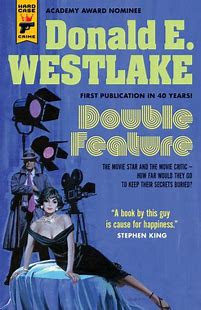
DOUBLE FEATURE by Donald E. Westlake

Double Feature, a 2020 release from Hard Case Crime and originally published as Enough in 1977, includes a short novel and a novella. The novel, A Travesty, is a slanted whodunit, which is more of a can-he-get-away-with-it since the protagonist – a film critic – is the murderer doing anything he needs to do to stay out of prison. A humorous story that begins with the genre’s usual, but grows into something quite original. The unexpected, but perfectly ironic ending, gives it a smile-inducing appeal.

The novella, Ordo, is more hardboiled than its pairing, and my favorite of the two because of its working class narrative. A career navy man, Ordo, discovers his short-time wife of fifteen years earlier has become a Hollywood sex symbol. She is unrecognizable as the girl he knew, and Ordo wants to figure out how his ex-wife became someone else. What he discovers is painful and melancholy, but has a purely American vibe of creating your personal mythology; similar to F. Scott Fitzgerald’s The Great Gatsby, but much less sinister.

Double Feature is a great pairing of tales, told in different styles and with contrasting themes, that showcase Westlake’s brilliance as a storyteller.

Monday, November 16, 2020

Thrift Shop Book Covers: "Hollywood Nocturnes"

Hollywood Nocturnes, by James Ellroy, was published in hardcover by Otto Penzler Books in 1994. The edition that caught my eye is Dell’s paperback reprint published in 1995. The bright and rich colors of the 1990s – orange and pink and that rich and deep purple – are exciting and enticing. And, there’s that accordion player to add a bit of “hmmh?” The artist: Unknown (to me at least)

The first sentence of the story, “Out of the Past”:
 

“A man gyrating with an accordion – pumping his ‘Stomach Steinway’ for all it’s worth.” 

Hollywood Nocturnes is a collection of seven of James Ellroy’s crime stories.

Monday, November 09, 2020

THE NICKEL BOYS by Colson Whitehead

This is review is for a book different from the usual fare at Gravetapping, but it is a marvelous and important novel that satisfies on every level of good literature. It entertains, it educates, it illuminates.

Colson Whitehead’s The Nickel Boys is as brilliant as it is uncomfortable. Elwood Curtis, a black teenager living in 1960s Tallahassee, is sent to a segregated reform school, The Nickel Academy, after the police catch him in a stolen car. Elwood was hitchhiking for the first day of his early-entry college class in the next town, when the car thief picked him up. His pleas of innocence go nowhere with the police or the judge.

Nickel’s staff trade the boys’ state allotted food to local businesses for kickbacks. They beat and whip any of the “students” perceived as trouble-makers. A few of the boys disappear into unmarked graves after severe beatings, the staff claiming they ran away. The boys are offered to local bigwigs as free labor. The pedophiles on staff have unlimited access to the boys.

The school’s degrading atmosphere is more than Elwood can stand. He wants to fight, in a similar way that his hero Martin Luther King Jr. confronts segregation and racism, but the more he struggles against Nickel, the harder his life becomes. The Jim Crow South setting is vividly drawn, uncomfortable, and for this naïve reader, startling. Elwood's journey from a hopeful boy, listening to King’s sermons in his grandmother’s house, to his descent into Nickel is both tragic and disturbing.

The Nickel Boys is fiction, but it was inspired by the very real Dozier School for Boys, which operated in Marianna, Florida, between 1900 and 2011. The beatings, killings, and everything else actually happened at Dozier, but the story and the characters are the invention of Whitehead.

Wednesday, November 04, 2020

Books in Film: "Dark Passage"

 When books appear as set background in film and television, I spend more time identifying the books than paying attention to the story. When a book gets actual screen time, it makes me happier than something so insignificant should.

This happened with David Goodis’ Dark Passage in the 1991 film, Past Midnight. A film I haven’t watched enough of to decide if a connection exists between novel and film, but man do I dig that featured Dell edition and, even more, its prominence the scene.

Past Midnight was directed by Jan Eliasberg, written by Frank Norwood (it is rumored Quentin Tarantino heavily revised the script), and stars Rutger Hauer, and Natasha Richardson.


Monday, October 26, 2020

Thrift Shop Book Covers: "Condominium"

Condominium, by John D. MacDonald, was published in hardcover by J.P. Lippincott in 1977, but the edition that caught my eye is Fawcett Crest’s paperback reprint published in 1978. Broken sunglasses, a tipping skyscraper, water surging across open sand, and the gold foil title always makes me look twice. The artist: Unknown (to me at least)

The first paragraph:

Howard Elbright finally found Julian Higbee, the condominium manager, lounging against a concrete column, staring toward the pool area where two young women were taking turns diving from the low board.

Saturday, July 11, 2020

THE TENTH VIRGIN by Gary Stewart

The Tenth Virgin, by Gary Stewart (St. Martin’s Press, 1983), is the best mystery novel set in Utah I have read. It is a private eye novel starring Gabe Utley. Gabe was raised on the east-side of Salt Lake City. He is a big city private eye, New York City, back in Utah as a favor to his high school sweetheart, Linda Peterson. Linda’s teenage daughter ran away, leaving a note that she joined a violent polygamist sect. Gabe is doubtful he can track the girl down, but his sense of obligation keeps him on her trail. The investigation takes Gabe into the wealthy and powerful Mormon hierarchy in Salt Lake City and then into the depths of the poverty-ridden polygamist clans of Southern Utah.

The Salt Lake City setting details a town that no longer exists—it is so much bigger now, less homogeneous—but it is done with a vivid and accurate hand. The narrative is crisp. The characters, from newspaper reporters to mean-spirited bigamist husbands, are nicely drawn with enough depth to make them familiar to the reader. The plot is nicely executed and the cultural examination of Mormonism (the culture, and not the religious doctrines) is spot-on. 

The Tenth Virgin is truly something special.  

Monday, May 04, 2020

TIEBREAKER by Jack M. Bickham


In 1989 a midlist writer named Jack Bickham published the slim suspense novel Tiebreaker. It was the first of six novels featuring aging professional tennis player, current teaching pro, sometime magazine writer, and former CIA asset Brad Smith. Brad is a step beyond the tail of his career and, after investing his prime years’ winnings unwisely, earns a living as a teaching pro at a club in Richardson, Texas. The novel’s opening is too good not to share—

“The last thing I had on my mind was somebody breaking into my condominium and dragging me into the past.”

It wasn’t on his mind because he was playing the finals of his tennis club’s first annual Richardson Charity Tournament against a hotshot college player acting like John McEnroe and threatening to clean the court with Brad. A battle between age and arrogance. When Brad makes it home, so both he and the reader can discover who and what is going to drag him into the past, he finds his old agency contact, Collie Davis, watching a western on television with a beer in his hand.

The agency has an assignment requiring Brad’s specialized credentials; a young Yugoslavian tennis star named Danisa Lechova wants to defect to the west, but her passport has been confiscated, and the UDBA (Yugoslavia’s version of the KGB) is openly watching her. Brad agrees, reluctantly, to act as Danisa’s go-between for the defection, using his cover as a tennis writer. 

The Brad Smith novels rank as my favorite featuring a serial character. Brad is uniquely American. He does odd jobs for the agency due to a perceived debt he owes—

“ask not what your country can do for you, ask what you can do for your country”

—but he often doesn’t like the assignments, or the agency’s work overall. In a sense he is supporting the lesser of two evils—meaning the CIA against the KGB and the Soviet Union. He is a patriot, but it stops somewhere short of murder, coups, criminality, and E. Howard Hunt. He has a conscience and a well-defined ethical awareness that is unique to spy thrillers. He is also likable, admirable, mostly, and has more trouble with women than imaginable.

The novels, and Tiebreaker is no exception, are written in both first and third person. Brad’s perspective is in first, and an assortment of characters, including good guys and bad, are in third. The alternating perspectives give the novel a hybrid feel—Brad’s narration is more closely related to a private eye novel with social commentary making it more personal, and the third person expands it into a broader and larger suspense-spy story.

The tennis is an integral element to the story, and it is described so well it becomes a secondary character—

“Somehow I got my Prince composite on the yellow blur and bounced it down the line, hitting the back corner, close. He glided over to get it and I thought I saw the angle and guessed, chuffing up toward the net.”

The suspense is expertly designed around the story questions—a clue is identified, but its impact and relevance is not revealed for several pages. It is done without any annoying tricks or contrivance. The characters—both Brad Smith and the secondary folks—are well defined without any doubts about motivation or outcome. There are no crazy monsters, or unexplained actions. Everything is logical and smooth.

I like Tiebreaker and its five sequels so well that I re-read the entire series every few years, and if I was any more weak-willed I would probably read them more often.